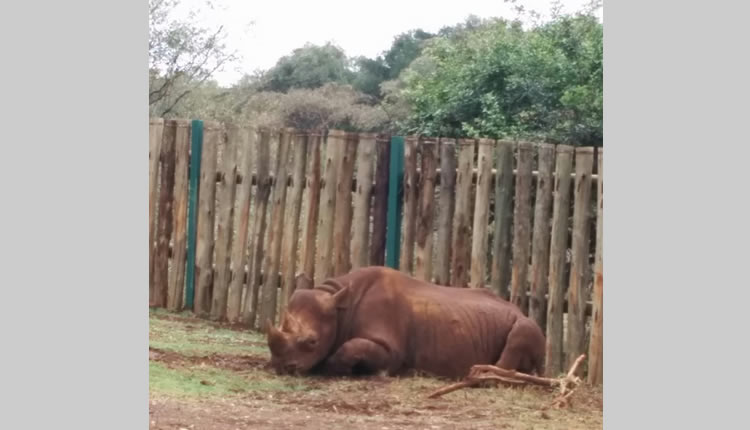

Maxwell laid on the ground staring straight ahead, his front limbs folded inwards.
FUNKE OSAE-BROWN
“Maxwell!” Julius Shevarigha, the animal keeper at The David Sheldrick Wildlife Trust conservation, called out to the big Rhino lying at the far end of his expansive stable.
The animal didn’t bulge. He called out again, this time with a little caution, “Max—we—ll!” the Rhino only managed to give a lame nod without looking in the direction of the voice.
“He is not in the mood today,” Shevarigha explains to our little group of the Google Gulliver Travel, as we stood outside the gated barn. Maxwell growls at our presence and the familiar voice of Shevarigha, his keeper.
“He would have stood up as soon as he heard my voice,” Shevarigha tells us. Apparently, it wasn’t the best of time to pay Maxwell a visit. Curiously, Maxwell laid on the ground staring straight ahead, his front limbs folded inwards. One could tell something was wrong but what it was we all didn’t know.
Our little group from the Google Gulliver’s Travel, which took place in Nairobi, Kenya in October 2015, arrived at The David Sheldrick Wildlife Trust a few minutes past midday. The David Sheldrick Wildlife Trust takes care of orphaned animals like Maxwell.
Few animals have suffered from the hands of poachers as elephants and rhinoceros. In recent decades, rhinos have been relentlessly hunted to the point of near extinction. Since 1970, the world rhino population had declined by 90 per cent, with five species remaining in the world today, all of which are endangered.
The rhino is prized for its horn. It is, however, not a true horn, but thickly matted hair that grows from the skull without skeletal support. The major demand for horn is in Asia, where it is used in traditional medicine and ornamental carvings.
In partnership with the Kenya Wildlife Service (KWS), the trust safeguards the natural environment, as well as provides veterinary assistance to animals in need, rescues and helps in rescuing and rearing orphan elephants and rhinos.
“Maxwell is a blind Rhino,” Shevarigha explains to us. “On one of our patrols in the park, we found him roaming aimlessly in the park on February 6, 2007. We were curious at first because of the way he was running into things in his way. We later discovered he was blind. He was a baby Rhino who was left behind by his family because he couldn’t put up with their pace. We found the park’s forest about 3 kilometres from our headquarters,” says Shevarigha.

Shevarigha and his team took the baby Rhino into their care.
Compassionate with animals, Shevarigha and his team took the baby Rhino into their care. They never knew he was blind. They built a stall for him to live in can immediately invited experts to attend to his needs. “The Kenya Wildlife Service (KWS) Rhino Unit was summoned, and together they and our keepers monitored the little rhino until dusk from a good distance so as not to disturb him or the possibility of his mother returning, and when there was still no sign of the mother, something had to be done to prevent him from being taken by predators during the night,” explains Shevarigha.
After careful examination, they later discovered he has a challenge with his sight. “By now, it had become obvious that he was completely blind in both eyes. He was physically overpowered, which took all the strength of about ten men, though, just a year old, he was immensely powerful. With legs tied, he was carried on the Elephant Rescue Tarpaulin to a vacant stable, but when he was released, Maxwell almost demolish the timbers of the stable,” he explains further.
The Rhino was later christened Maxwell as a way of given an identity which he never had until he was found roaming in the park. After he was rescued, for three days, no-one could set foot in his stable, he was so wild and fierce, but he soon understood that milk and water was available at the stable door.
Maxwell was later given antibiotic injection by Robert Carr-Hartley, a specialist animal physician, to forestall problems brought about by trauma and shock. His assessment of the cause of Max’s blindness shows that he was suffering from bilateral cataracts, which required surgery.
And on March 21, 2007, the cataract operation was performed on Maxwell’s left eye. Dr. Dieter Rottcher handled the anaesthesia while Kenya’s top eye specialist, Dr. Peter Schwendemann, performed the surgery. In spite of all these, little Maxwell was yet to regain his sight.
His keepers didn’t stop at that on January 11, 2008, they invited Dr. Antony Goodhead, a specialist ophthalmologist from the Johannesburg Animal Eye Hospital, South Africa, to do a thorough investigation on Maxwell’s eyes. He discovered that his eyes were sunken and smaller than he would have wished to see and this disturbed him, suggesting additional problems over and above cataracts.
After extensive ultrasound examinations, it was confirmed that Max’s problem was one of multiple congenital complications with both his eyes and that they were beyond repair. His retina were also detached. And so, surgery was not able to restore Maxwell’s sight. And so, Maxwell has to live with that for the rest of his life.
He has accepted his fate, he lives in his large barn without romping into his large bath up and water kept on one side. That afternoon, we watched sleep on his bed made of dried straw. After his first growl at us, he was quiet as he drifted to sleep nodding gently until his head stopped moving.
About The Author