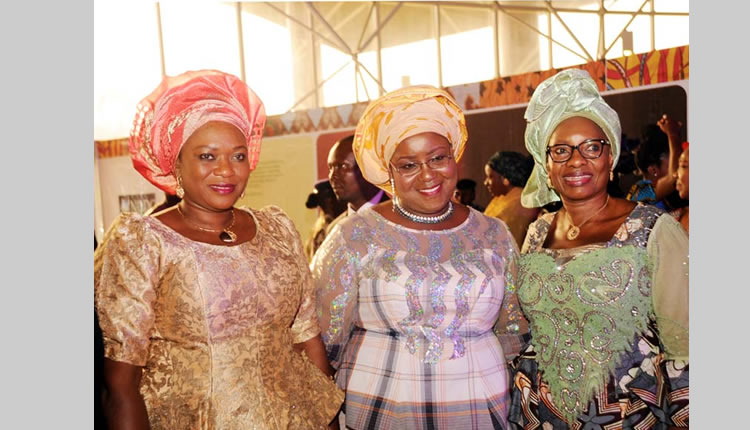

Ibim Semenitari, acting managing director and chief executive office NDDC (middle) with representative of the first lady, Mrs Aisha Buhari at the event
The large stage at the International Conference Centre, Abuja, came alive to the rhythm and voices of women from all over the country on Sunday in celebration of the International Women’s Day.
The event put together by Niger Delta Development Commission marks a turning point in the affairs of the commission under the new leadership of Ibim Semenitari, acting managing director and chief executive office NDDC. It is the first time the commission will host a stage play to highlight the plights of the Niger Delta Women.
Written by Ahmed Yerima and directed by Niji Akanni, ‘Little Drops’ tells the story of four women who are connected through their dangerous experiences in the Niger Delta crises. The play calls attention to the wanton destruction of life and properties in the region and the attendant physical problems. The play echoes the need for caution and appeals for peaceful resolution to these issues.
The plot of the play is woven around Memekize (played by Tosan Adremoda-Ugbeye) who lives by the river. She has been devastated by the effect of the senseless killings and war between the Niger Delta Militants and the Joint Military Taskforce (JTF). She has lost her children to the war.
Memekize’s little hut by the riverside becomes a refuse of sort for all the four female characters in the play. Mukume (acted by NajiteDede) is raped by three militants who invaded her matrimonial home on her wedding night. She never knew her husband is a militant.
These women are later joined by Azue, the queen who runs away from the palace after the militants reduced the palace and the shrine to rubble. She flees with the only surviving prince only to find out when she gets to Memekize’s hut that the little Prince strapped to her back is dead. On a single night she loses her husband and son.
Ahmed Yerima’s ‘Little Drops’ can be compared with Bertolt Brecht’s ‘Mother Courage and Her Children’, widely considered one of the greatest dramatic creations of the modern stage. The work is the playwright’s most passionate and profound statement against war and the attendant carnage. In the same breath Ahmed Yerima’s Little Drops written looks at the devastating impact of war on women and children.
A socio-political realist play, ‘Little Drops’, signifies the social and political reality of the country from which the people emerge. It shows that women and children are the primary victims when there are domestic conflicts that involve the use of arms and ammunition as is the case of the Niger Delta militants versus the Joint Military Taskforce (JTF).

It was a night of fun, dance, dram and poetry
This position is brought to fore in the experience of the character, Bonuwo (played by Joke Silva), a class teacher who leaves her children in the class to answer nature’s call in the restroom. To her chagrin on her return, her class has been raised down by fire with cries of burning innocent children filling the air. She puts it aptly:
“I am a school teacher teaching primary two of students ages seven to eight,” she says as she narrates her ordeal to Memekize, Mukume and Azue. “I went to the restroom only to return to find the windows of my classroom blown off by explosion with smell of burnt skin.” She had to run away from being lynched by aggrieved parents who she had earlier convinced to send their children to school.
In her opening remarks titled ‘It is Time for Women, the acting MD, NDDC, Semenitari says throughout history women have excelled in spite of the narratives and laws of society, written, spoken and silent, which have conspired to make them weaker than men.
“In most communities, of the world, these have threatened and in most parts, succeeded in confining women to sub roles in politics, the workplace, education and the home. In these societies, women still struggle to be acknowledged in equal measure as men. Even in the Niger Delta region, where I am from, women who have increasingly established themselves as breadwinners of their families, still find boundaries and hurdle foisted on them.”
According to her, it is in the light of this perception of the woman that NDDC has decided to stage the play, ‘Little Drops’.
“Tonight’s play,” she explains, “so unimpeachably rendered by professor Yerima, shows the women of the Niger Delta are faced each day by great environmental, political, social and economic challenges. The society, so easily neglects—and inadvertently, stokes— their torment. Women and children have suffered, for too long, the consequences of the conflicts in the region.”
Also, in her remarks, wife of the president, Aisha Buhari, who was represented by Pauline Tallen, former deputy governor of Plateau State observes that in this month of celebrating womanhood, ‘Jewels of the Niger Delta’ could not be more than apt a theme to capture the beauty and essence of the season. She also urges men and women present at the occasion to pledge for parity.
“I urge you to pledge for parity to take a concrete step to help achieve parity more quickly, whether to help women and girls achieve their ambitions, to create gender balance leadership, respect and value difference and to help develop more inclusive and flexible cultures that will root out workplace bias.”
Furthermore, the night was a total package of all aspect of the arts as Titilope Shonuga and Wanawana Udobong recited poems to highlight the different aspects of gender inequality in the Niger Delta region.
In her two poems, Shonuga emphasises the different socio-economic women facing women. She asks the rhetoric question: ‘Have you ever seen a woman come?’ to drive home her message of the suffering, rejection and emotional trauma faced by women.
Likewise, Udobong in her poems, ‘Darkness’ and ‘You’ll Not Be a Catfish, Point and Kill’ shows the another side to the suffering of the girl child whom she compared with the famous catfish that men point to, to be killed and served at pepper soup joints. She caps her performance for the night with Nimnon Bassey’s poem, ‘We Thought It Was Oil, But It Was Blood, a poem that talks about the other side of oil discovery in the Niger Delta region as a curse rather than blessing.
About The Author