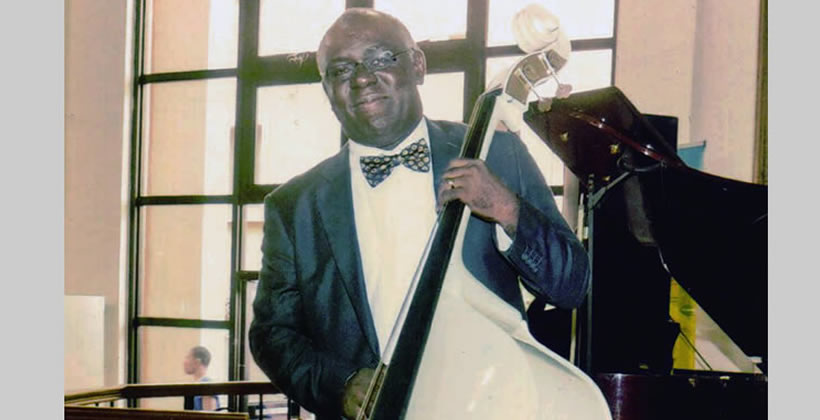

Egbe is a classical music enthusiast and host of the Radio Show, Classical Journey on Radio One 103.5 FM.
A broadcaster and lover of classical music, NKANU EGBE, is very versed in classical compositions. In this interview, he tells FUNKE OSAE-BROWN, how he acquired a lofty taste for music.
His Surulere home was not difficult to locate. We had had a brief chat a couple of months ago about his interest in Classical music. I decided to find him out. And so, my curiosity, about this dark man who I met online, led me to the modestly furnished apartment of Nkanu Egbe. He simply loves to be called NK. He doesn’t like to be addressed as ‘sir’, not even the prefix, ‘Mr.’ can be added to his name even though he is much older than I.
Egbe is a classical music enthusiast and host of the Radio Show, Classical Journey on Radio One 103.5 FM. His foray into Classical music began many years ago at Radio Nigeria where he was exposed to music by the likes of Sam Akpabot and Adam Fiberesima. His understanding of Classical music is legendary although he never studied music.
He tells me the foundation of every music is classical. “This is why I say so. Firstly, you find that, music is made up of tones, different elements that are Classical music. And everybody who is a musician has to be able to know these things. Before you are able to do say the Jazz drums, you must know that there is a rhythm.”
According to him anyone playing the guitar must know that there is a melody as rhythm and melody makes a good music. “Apart from rhythm, the sound is going to be according to the different tones. That understanding when it comes to appreciating classical music, must be there. You know there is tone and there is rhythm. I know that everybody who studies classical music has that knowledge.”
As earlier mentioned, Egbe is a trained broadcaster. His experience in Classical music actually stemmed from broadcasting. For him, Classical music finds its root in Folk music. “Anybody who studies Classical music they will tell you that the foundation of classical music is your folk music. So it is just that we don’t have many composers back here in Nigeria.”

Classical music for Egbe should involve the fusion of traditional music and not just foreign sound, rhythm and tones.
Classical music for Egbe should involve the fusion of traditional music and not just foreign sound, rhythm and tones. “We are supposed to be hearing a lot of Apala, kontigi in Classical music. We are supposed to be hearing the Eastern sounds, the Igwe and the rest of them in Classical music. You notice that People like HRH Obi Professor Laz Ekwueme and the rest of them when they composed music, they composed music not because Oyinbos want to hear what they composed. They wanted to capture the Nigerian sounds. Music is supposed to be appreciated not just by one audience but by a universal audience. In so far, it is pleasing to the ear.”
Egbe had a little foundation in Classical music as a student of Federal Government College, Enugu. But he couldn’t continue with the music class due to financial challenges, however as fate would have it, he found himself at Radio Nigeria where he robbed shoulders with some of Nigeria’s music greats.
“If you take note of some of the things you met along the way, they may have influence you as you go on in life,” he says while recalling his days in Enugu. “I was interested in music in secondary school. I think I had to drop it at class three when I was to pay for my grade one theory of music and I didn’t have money to pay. I had to drop out of music and chose to do Fine Art.
“Those are the challenges I faced growing up. But I have always had interest in music but going to my broadcasting days I have always had interest in music. I worked with some of the best musicologists in Nigeria the likes of Fela Anikulapo who also passed through Radio Nigeria.”
Based on his experience, he argues that music is something everybody must invest in. “It is something everyone must spend money upon. This is a challenge we have as a country regarding the study of music. For instance, if you are talking about the sciences, you must have a laboratory, for you to be able to appreciate the different sciences. Music in itself needs to have its own laboratory. Anyone who is interested in music must have his tools. And when it comes to writing exams you must have the money to pay for it.”
In addition, he wants people to appreciate the fact that the foundation of every tune that they hear is classical music. “Let me take you back to the 1990s where Coolio came up with a rap called song, ‘I will see you when you get there.’ The foundation of that song is classical music Pachelbel – Canon in D Minor written far back as the 18th century or so. He wrote during the classical era or I think he was from the Baroc era. You can imagine a tune as far back being used as a foundation for a Rap song today. We are doing a Canon in D Minor and you tell a young man and he will tell you this is Coolio’s song.”
His stint at Radio Nigeria made him encounter HighIife fully. While in training at Radio Nigeria he met professor Adam Fiberesima who was a composer. “He was in charge of the music section of Radio Nigeria. He had written a few compositions. One of them has to do with Highlife Fantasia. Highlife Fantasia included the works of people like Rex Lawson. It is a very fantastic thing to listen to. You could hear the Highlife raves in his compositions. And it was fantastic that Nigerians could capture that.”
Sam Akpabot, who also worked for Radio Nigeria influenced Egbe’s taste for music. Egbe was influenced by a few classical compositions written by Akpabot. “I am sure you will be familiar with the song, ‘Onidodo, Oni Moinmoin’, that was a Sam Akpabot. Maybe he didn’t compose that song, may be it was a folksong but he did it in the classical format. The National Orchestra of South Africa performed some of Sam Akpabot songs.”
Furthermore, Egbe loves the music of Godwin Sadoh, a composer and pianist and Ayo Bankole senior who did a lot of compositions. ‘Keresimesi Ma Tun De’ one of Bankole’s compositions, is a popular Christmas classic. Bankole died in the 1970s but his songs are still relevant today.
“Maria Asevah she puts together a whole collection of Ayo Bankole’s songs,” he recalls. “From there you can get to appreciate some of the piano works that he did. I am talking about the fact that behind any classical piece that you hear there is folk song, lets even take the foreign classical masters, Beethoven, symphony nine, one of his most popular songs ‘Ode to Joy’.
“After wards, there is Joyful, Joyful, We Adore Thee’. Now the ‘Ode To Joy’ was actually written as a poem. Antonio Delvadie was more of a church man. Most of his compositions skewed towards church music. And today you can listen to Delvadie again and again. There are many interesting Highlife songs that come with great rhythm. For Ghanaian Highlife the beat is 4:4 (three beats and a rest) while the beat for Nigerian highlife is also 4:4 (three beats and two quick beats which Victor Olaiya refers to as 5:4).”
About The Author