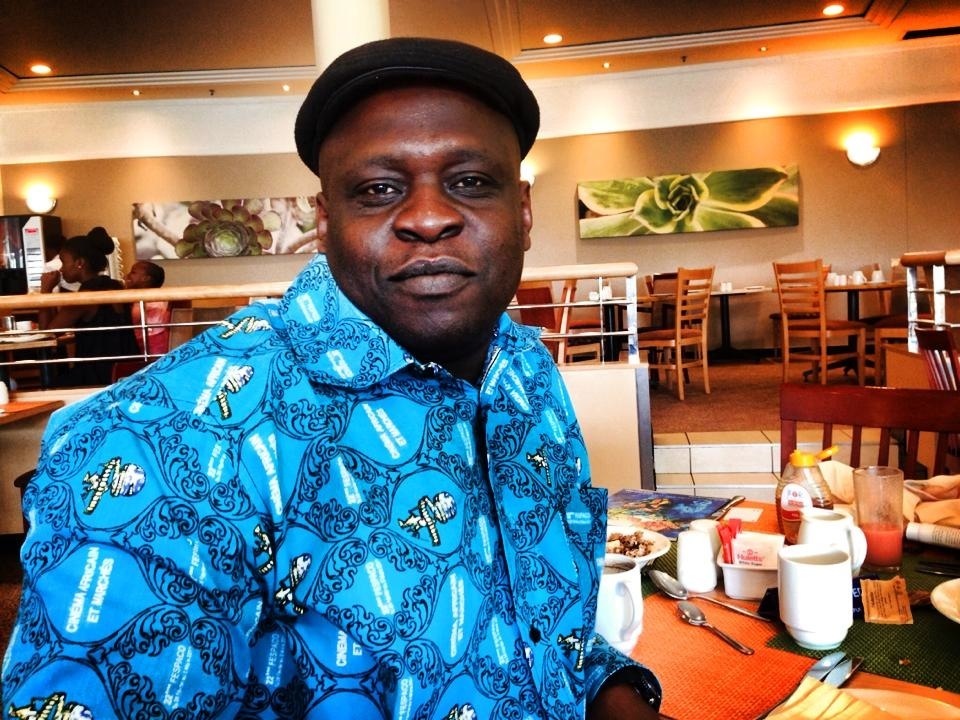
SHAIBU HUSSEINI is a dramatist, film critic who is very passionate about the arts. Recently, he was appointed as a member of the Abuja Carnival Management Committee. In this exclusive interview, he tells FUNKE OSAE-BROWN about his role in the carnival and his film career.
Congrats on your appointment as a member of the Abuja Carnival Management Committee. How did you get appointed?
I think I was in the library in the University of Lagos when I got a call from the office of the Honourable Minister of Information and Culture informing me of my nomination as a member of the Carnival Management Committee (CMC). Although, I consider myself, and I say this with all sense of humility, a key stakeholder and strong player in the arts, film and culture scene, but I never saw this appointment coming. But the call came and it came with an invitation for me to attend the inaugural meeting which happened a day before we had the Africa Movie Academy Awards (AMAA) ceremony in Port Harcourt. I cleared from my bosses and they said it was okay for me to honour the invitation as it was a plus for the institution that a staff of the parastatal was recognised at that level and I also cleared with the founder of the AMAA Ms. Peace Anyiam Osigwe because I was head of the AMAA jury for 2016 and so my trip to Abuja for the inauguration of the Carnival Management Committee was going to steal a few hours from our final deliberation. Anyway, I attended the inaugural meeting, which was chaired by the Honourable Minister Alhaji Lai Mohammed and then I returned to join the AMAA jury camp and the next day we were in Port Harcourt to successfully deliver the 12th edition of the AMAA’s. I must thank the Honourable Minister for the appointment and for the confidence he reposes in my ability to contribute to the success of the carnival and by extension the theatre, cultural and film sector. It’s a call to serve the nation and service we must give.
What should we be expecting differently for this years carnival?
This year’s Abuja Carnival will close as one of the best that will be organised since the inception of the carnival. I say this not because I have been appointed a member of the CMC and this is not to discredit previous editions. But I have followed the operations of the Abuja Carnival from inception so I know why I think this will turn out the best that will be organised. I was both Personal and Special Assistant to the one-time Director General of the Abuja Carnival Professor Ahmed Yerima. I have even served at various capacities by virtue of my position as Special Assistant to Professor Yerima who was also Director General of the National Theatre and National Troupe. I worked closely with him at the National Troupe, then the National Theatre; later the Carnival when he was DG and even head of technical. So, somehow I know the story, inner workings and operations of the carnival from inception to when he left as DG. But here is what will make this edition and future editions different and better organised. We have a Chairman and a Co-chairman in the Minister of Information and Culture and the Minister of the Federal Capital Territory (FCT) who are both interested and passionate about developing this carnival into a huge cultural product that will be used to drive tourism. I have attended two meetings so far and the Ministers have chaired these meetings and have been pointing the way that we should go as a committee. This has never happened in the history of the carnival, where two ministers will work in cooperation and chair CMC meetings. In fact at one of the meetings, the FCT Minister was advising on how he thinks the street party should look like. When you have people at that level getting involved even at the level of re-shaping the concept, then you are assured that all the facilities you need in the territory to ensure a smooth carnival will be in place.
Secondly, this is the first time we will be having the carnival held under the combined Ministry of Information and Culture. Before now, it was held under the defunct Ministry of Tourism and Culture. So what used to happen before now, was that the Culture Ministry will organise the carnival and then they will go cap in hand begging for media coverage and live telecast of the carnival events from big network stations like Nigerian Television Authority (NTA) and the Federal Radio Corporation of Nigeria (FRCN). But you have all that now and even more under the same ministry and directly under the supervision of the Minister. Now we have even Voice of Nigeria (VON), there is the News Agency of Nigeria (NAN) and the National Orientation Agency (NOA) and so on. With these agencies we are sure of massive mobilization and sensitization of the carnival programmes and activities. Interestingly, the Minister has co-opted the Chief Executives of these agencies into the committee but as ex-officio members. So they are compelled to give the carnival and its programmes and activities massive publicity. This is however not to say that we wont rely on other broadcast and print media organizations for publicity. Of course, we will, definitely. The carnival is a national carnival. It is for us all. It should be to us what the Rio carnival is to Brazil.
And the third and fourth reason why I think this carnival will be the carnival to beat is that the FCT administration is fully involved at all the levels from the Ministerial level to the last operational level and so all the logistical needs like accommodation, health care, security, route mapping, sanitation and transportation will be taken care of. Also, we have a situation where for the first time the two ministers have agreed to lead the marketing and the contact and mobilisation drive. So clearly, this is going to be a different carnival. Call it a carnival of Change if you like.

‘Change has come for the carnival.’
Is carnival of change the theme this year and who are those you are working with on the carnival this year?
No, I just used that expression to let you know that change has come for the carnival, which the Minister considers one of the core mandates of the Ministry of Information and Culture. In fact Alhaji Mohammed is so drawn to the carnival because he considers it a unique platform for participating states, countries and independent groups to showcase their diverse cultural heritage. He also sees it as a product we can etch permanently on the cultural and tourism map so that people from all over the world can look forward to dedicating four days annually to attending the carnival. But the theme of the carnival this year is ‘Creative Industry: A Pivot to Economic Growth’ while Ace Creative designer, theatre artiste, director and cultural producer Biodun Abe is returning as Artistic Director of the carnival. Abe has directed only one edition successfully. Last years edition would have been his second but that edition was shelved because the Minister was appointed barely a week to the start of the carnival and he was not, as we were told, satisfied with preparation that were put in place then. So rather than just have the carnival for the fun of it, the Minister advised that it be shelved so that more planning can go into making the carnival a true carnival. So planning for this edition started immediately he assumed office and in a matter of days both Ministers will hold a major press conference to unveil the programme and announce the dates of the 2016 Abuja Carnival.
When did you start your foray into theatre arts?
I think I started earning money as a theatre artiste in the early 1980s and this was even when I was in high school. So I started out very early. And apart from what we did as members of the debating and cultural society in school, I used to get paid for performing skits at the NTA in Makurdi, Benue state and I was a guest artiste with the Benue State Performing Arts Company where I actually cut my professional teeth. From that company, I was recruited to form the nucleus of Alom International Theatre Company under the direction of Mr. Richard Tsevende. The company was to be sponsored by the late first civilian governor of Benue State Mr. Aper Aku but the dream died with his untimely demise. While at that I had a thriving career in broadcasting running. I was engaged as a presenter or OAP as we call them now at the Radio Benue 2 FM stereo Makurdi and then I presented mostly youth and children’s programme on NTA Makurdi.
I was doing all that and enjoying it until I heard of the audition into the National Troupe in 1988. I applied to be auditioned and the late theatre doyen Chief Hubert Ogunde who was the first Artistic Director and Consultant of the National Troupe auditioned us. I think we were about 1000 people that were auditioned but only about 15 of us were successful at the end. Then in September 1989, we were invited—about 120 of us from all the states of the federation, to form the core artiste body of the National Troupe of Nigeria. I recall announcing on radio, that I had received a call to head to Lagos on national assignment and that I was going to miss the huge fan base I had built. So I quit the job on radio and reported to the Ososa camp of the National Troupe. Chief Ogunde is from Ogun State and has this expansive compound in his hometown in Ososa. So we rehearsed in the compound and were quartered in hostel accommodation in Ososa town. Interestingly, it was while in Ososa that I developed another passion, this time for film. Ogunde ran a very successful film production company and when he asked for volunteers that were willing to be mentored in the area of film production and distribution, I volunteered and became part of the film production company crew. I travelled with the crew round the country showing Ogunde films, helping to operate the projector and just generally learning at the feet of the master artiste. And Chief Ogunde was a good mentor because he gave me books to read and he was always willing to explain whatever I found confusing. Am sure if he had not transited in 1991 shortly after we returned from Jos where we had gone to shoot the Hollywood movie ‘Mr. Johnson’ I would have ended up a filmmaker. But he died and I continued with dancing and theatre practice and much later I veered into Public Relations, film and then mass communication. I have been a part of the National Troupe local and international theatrical exploit and I have served the industry in many capacities including being the pioneer President of the Dance Guild of Nigeria. I have also served as Secretary of the Governing Board of the National Theatre and National Troupe for about six years. I was Secretary until the present dissolved the governing boards of Federal Government institutions. If you put that together with how long I have worked around and about the National Theatre and the National Troupe, then you will know that I ought to know the in and out of the National Theatre and of course the Troupe. But I think I have reached my last bus stop in terms of career interest. If I ever have to veer again, then it will be first to the academia and then to politics. I have a strong desire to contribute to the human capital and political development of this country.
Based on experience with theatre in Nigeria, it is like that genre of arts is dying. What do you have to say about this?
Well I won’t say it is dying rather I would say that it is at the stage it is because the practitioners have not been receiving the desired attention from government and the private sector. Theatre artistes and plays to be performed are not in short supply in the country. We have some of the best-known actors, directors and playwrights in the world, but what we lack is the space to perform, the enabling environment needed for theatre to thrive and funding. There are very few performance spaces in Lagos. Even when you go the other states, I mean outside the cultural centres and this is for states with cultural centres, there are no spaces for people to perform plays and so on. Even in the FCT, there is no a single theatre for performances. Some of the spaces that exist here in Lagos like Freedom Park, Terra Kulture have been over stretched. Some venues where we even take plays to are not suitable for performances and are also very expensive. I mean, you have a budget of ten million naira and you have to spend six million on venue on the island. What will be left to stage the production with? I mean, theatre productions should be subsidized as it is done in other parts of the world. I hold strongly that plays should be performed in theatres meant for it and not in make shift stages in hotels and courtyards. So the practitioners need the spaces and they need funding especially non-conditional funding and grants to produce theatre for theatergoers. It cost so much money to put a play together but the amount a corporate organization will use to support theatrical production is negligible compared to how much they will spend in sponsoring some reality shows that are not as impactful as plays that can be used to educate and entertain people.
For theatre, you have to consider cost of rehearsals, costumes, set, cast and crew and so on. Without sponsorship, it will be difficult for any producer to break even, talk of making profit. Once, I suggested that we must include in our national housing policy a provision that will make it mandatory for anyone constructing a high rise office complex to build at least a 200 seater auditorium that can be used for film shows and theatre. You can imagine what the implementation of that kind of policy will do to theatre and the film business in Nigeria. I have also suggested that a percentage of what is paid as entertainment tax be ploughed back into an endowment fund so that artistes can apply and source funds that they can use to produce arts. You can also imagine what that will do to the business of the arts in Nigeria. I also suggested that incentives like tax rebate be given to companies that sponsor theatre or the arts. Do it to one or two companies and others will fall in and then business for the artistes will flourish. People can now allow plays to run for a longer time because there is someone taking care of cost of venue. In other climes, plays run for as long as 30 years. But you can’t leave a play here to run for even one month because the space will suffer and the cost will be scaring. So once we can create the enabling environment, provide spaces like community theatres in each local government area in the country and also provide grants, things will fly and then you will no longer see theatre as an art form that is dying. Theatre needs to be subsidized and government has a responsibility to support not just theatre but the arts. It is in the constitution and that is why there is a Ministry in charge of the Arts, which is the Ministry of Culture. And I am happy that the Honourable Minister is thinking seriously of putting down structures that will ensure growth for the creative industry.
I am aware that he is working assiduously at getting the moribund National Endowment Fund for the Arts (NEA) off the ground and I am also aware of the high level meetings he has been holding with relevant government agencies and the private sector to ensure that we have a workable cultural policy and tourism master plan. I mean look at the speed with which he organized the recently held culture and tourism summit in Abuja. I am aware that a committee has met over the summit report and they have advised the constitution of a presidential council on culture and tourism that will see to the full implementation of the summit resolutions. I am also aware that the Minister is seriously working on resolving the distribution quagmire and helping in the current effort to fight piracy. I am sure that if the Nigerian Copyright Commission (NCC) was under his supervision, we would have seen some action in that direction. So we as creative people must rally round and give the Minister the kind of support he needs to implement all he has lined up for the creative industry. I have followed his proposals for a virile cultural and tourism industry and I must say they are well thought out.

‘Theatre artistes and plays to be performed are not in short supply in the country.’
You have been on the jury of many international film festivals and awards, how would you rate Nollywood as at today?
I think Nollywood has come of age. The industry is doing well. The practitioners, who as I must admit are working under very harsh conditions, are also doing their best to meet up with acceptable standards. Some people who hitherto viewed the industry as the industry of quantity and not quality are beginning to change that narrative. We have practitioners who are resolved to up the ante of movie production and that is reflected in some of the awards and recognitions that have come for some of the industry practitioners. In fact I would say that many people are turning towards the direction of Nollywood because Nollywood even to the west that once wouldn’t touch it with a long pole, is the next big thing. But Nollywood, which is the name that I want to adopt in describing the entire motion picture industry, is the happening thing now and we must credit the tenacity of the practitioners. They have continued to work without the required support and they have continued to remain in going concern despite the activities of pirates and the near lack of a distribution structure. I mean, I was excited when the organizers of the prestigious Toronto International Film Festival (TIFF) announced that Lagos, which is home to our dear very own Nollywood was the focus of their city to city project for the 2016 edition, which will be held in September in Toronto, Canada. The city-to-city project is a special spotlight on films and filmmakers from a city where interesting works are being made. That is a big one for the industry even though we seem not to be excited about it. But we should. This is a major showcase of the best of Nollywood. The world’s attention will be on Nollywood for the ten days that the festival will run. Go and Google TIFF, it is one of the world’s biggest film festivals and the largest gathering of filmmakers, film agents and distributors. It is one big platform for internationalizing Nollywood and for bringing the ‘real’ offerings of the industry to the people that matter. Some of these international sales agent won’t touch Nollywood movies even with a long spoon because they have been fed with some crap on some cable stations and on some pay per view platforms and so when they think of Nollywood, they think it as an industry that still makes crappy films. But we have grown beyond that and we are aiming at breaking new grounds since we seem to have conquered Africa. So I think we should in fact have a national and state representation led by the Minister of Information and Culture at TIFF this year. We can even have states that are open to film business like Kano, Delta, Cross Rivers, Anambra and Enugu join in the delegation so that they can sell their locations to people who may be interested in co-production deals that will come out of the business sessions that will organized as part of this special showcase. Unfortunately, we don’t have a Nigerian Film Corporation (NFC) and a National Film and Video Censors Board (NFVCB) that are alive to their responsibilities.
They should have been anchoring this unique outing and ensure that we take full advantage of it if their leadership know what time it is. But they certainly don’t know the time and are at a loss as to how we can take advantage of such a huge platform. In fact I was talking to some folks at one of the agencies and they were completely at a loss. Toronto or any other festival will not be focusing on movies from South Africa and or Kenya and the South African National Film and Video Foundation or the Kenyan Film Commission will be at a loss. Not only will they be fully involved, they will exploit this opportunity maximally and will make their outing in any of these international meets, a huge show. Some of us that have been to these festivals like in Cannes and Venice and Berlin can attest to how South Africa packages the industry and the practitioners for participation. No wonder, South Africa has recorded so many co-production deals. But sadly, the agencies that are supposed to regulate and help grow the industry in Nigeria are at a loss. They are not showing leadership at all. There is presently a disconnect with the industry they are supposed to be regulating. And since they are at a loss about what to do, I think a relevant industry association should approach the Minister of information and Culture to see how we can take advantage of this priceless outing in Toronto to present Nollywood to the world. This is the kind of thing a Peace Anyiam Osigwe can use the platform of the AMAA to handle on behalf of Nigeria but you know, the politics in moviedom is bigger than what you have on the real turf. But I really don’t care who is going to get the Federal government interested in taking advantage of this platform that TIFF has provided. What is important is our participation as an industry and as a country. We must begin to put our best foot forward and this is a golden opportunity.
Having said that, I think to get Nollywood to its desired height, we need to build more capacities especially in the technical area. It will interest you to know that we still have finger countable production designers, cinematographers and sound specialists almost twenty years after the boom in the video industry. We need to build capacities in those areas and in scripting for film too. Also, we need to set up a lot of funding mechanism to enable filmmaker’s source funds for production. We should have more of the Project Act Nollywood film funding initiative. Not just more, but something that can be sustainable and that will outlive the initiators. Which is why I am one for the National Endowment Fund for the Arts (NEA) that the Minister of Culture Alhaji Lai Mohammed wants established. Also, we must solve the distribution challenge. Encourage the setting up of more cinemas especially community cinemas across the country and also encourage people to set up well laid out media stores across the country so that people can get original copies of creative works real-time.
One of the reasons piracy has thrived is the lack of effective distribution. Once we can get movies to all the nooks and crannies of this country and sell them at the same price pirates are selling, the pirates will look for something else to do. The other thing we need to do is to reinvigorate and strengthen the National Copyright Commission, fund them adequately and strengthen the anti-piracy laws. We have had a Presidential declaration on Piracy already. That was one of the first things that President Mohammed Buhari did on assumption of office. But we need to go a step further by declaring a state of emergency on piracy and also by declaring piracy an economic crime so that agencies like the Police and the Economic and Financial Crime Commission can be more committed in prosecuting pirates. At the moment, someone pirates your work and all he gets is a three months jail sentence with an option of fine of less than one hundred thousand naira. Naturally, the pirate will pay the fine and still continue the business. So we need to strengthen the law and make the penalty stiffer. Also, we need to encourage more investment in the establishment of post-production studios. We still have to take our jobs abroad for colouring, sound design and so on. So much capital flight. But we can set up studios here so that we don’t have to take all our jobs abroad for post-production. I must commend the Bank of Industry for their intervention in the area of providing funds for equipping existing studios and in the area of providing funds for productions. But we need more of such interventions. The other thing is that we need to professionalize the industry and work within acceptable codes and ethics. There is so much confusion and too many associations and guilds. A lot of people are afraid to do business with Nollywood because of the confusion in the industry. I think the time has come for a structure like the Motion Picture Practitioners Council. It should be industry driven and it should seek to regulate the practice of motion picture in Nigeria. Such a council should maintain register of practitioners and prescribe acceptable codes and ethics that will be reviewed from time to time.
About The Author