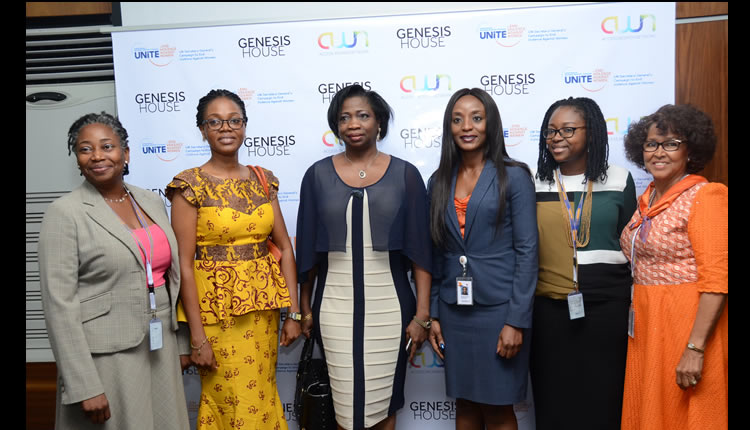

L-R Executive Secretary, Sesor Foundation, Ier Jonathan- Ichaver; CEO, Nigeria Women Trust Fund, Olufunke Baruwa; Keynote speaker, Hon Abike Dabiri-Erewa; Head, Treasury, Sales and Trading, Access Bank Plc, Sunmbo Olatunji; Executive Secretary, Freedom Foundation, Olusola Adeola and Programme Director, Genesis House, Helen Nwabuokwu, during the Access Women Network/Genesis House lecture titled “Empowering Women to End Violence” in Lagos recently.
FUNKE OSAE-BROWN
The head office of Access Bank located on Danmole Street, Victoria Island stood resplendent in the early Thursday morning sun. The gushing sound of the water fountain at the entrance could be heard a few metres away. The crystal clear colour of the water shines brilliantly in the sun as I climbed the stairway to the reception.
As expected, women of all ages were waiting to get registered at the reception. This did not come as a surprise to me at all. It was a women’s day. It was a gathering of women from all works of life as Access Bank’s Women Network and Genesis House held The Orange Lecture entitled ‘Empower Women To End Violence’. The lecture was in support of the Global Campaign to End violence against women.
After I was given my Access pass, I took the elevator to the ninth floor. Access Bank is very passionate about women hence when they call for a meeting on women issues it is usually well attended. The well-arranged hall was almost half-filled when I arrived. A couple of minutes later, the event began.
Sunmbo Olatunji, head of Treasury, Sales and Trading, Access Bank Plc, said in her welcome address that there are 4.5 million victims of sexual violence in Nigeria. 98 percent of whom are women and girls. According to her, 700 million women worldwide are married as children while 250 million girls under age 15 are married. It is for this reason Access Bank has decided to support the 16-day campaign tagged ‘Orange the World’ declared by the United Nations to stop all kinds of violence against women.
“Violence against women or girl has become silently accepted in the society,” said Olatunji. “It is one of least prosecuted cases. The silence has to be broken now. There should be a place for family shelter when a woman is ejected from the home.”
Keynote speaker, Abike Dabiri-Erewa, a journalist and former member of the House of Representatives, shared some of her experiences as a reporter for NTA. She narrated the experience of an 11 year old girl who was raped by two men, Alfa and Uncle Yomi. “The parents were poor and they couldn’t get justice,” she recalled. I had to get them out of the house. The girl is now a graduate of LASU.”
She also told the story of a widow who had to bath with the water used to wash her husband’s corpse for two weeks. She was compelled to stay in the bush for seven days. “The widows are helpless in Nigeria,” she added.
In addition, she talked about the ordeal of a woman who was raped by two armed robbers in her house in the presence of her husband. “The husband said I can’t stand her. She should get out of my house.”
With these numerous experiences Dabiri-Erewa was encouraged to pursue the Bill on Violence against persons into law. According to her, she worked with some NGOs to ensure the bill scaled through.
“It took us 12 years to get the bill passed into law. Violence against women is more endemic in Nigeria. One out of four women in Nigeria is a victim of violence. Every four women have been victims of violence. Children are being raped by relatives. When a woman is battered it affects her psychologically. It comes with a lot of emotional trauma.”
One of the discussants and executive secretary, Sesor Foundation, Ier Jonathan-Ichaver said stopping the violence starts with individuals. “We have to examine our homes. We need to start examining ourselves as women. Until we start changing our attitudes we won’t see the change we need.”
Olufunke Baruwa, another discussant and CEO, Nigeria Women Trust Fund, is of the opinion that trafficking has nothing to do with gender. “You violate someone you think you have authority over. Trafficking has nothing to do with being male or female. There are some people who maltreat their housekeepers. He or she is rendering you a service so you must relate with him or her that way not as someone you have power over.”
The third discussant, Sola Adeola, executive secretary, Freedom Foundation, argued that culture is key when issues relating to violence against women are discussed. “Culture is so entrenched in individuals. We must begin to talk about how we can change perceptions because some women believe it is a sign of love for their men to beat or punish them.”
About The Author