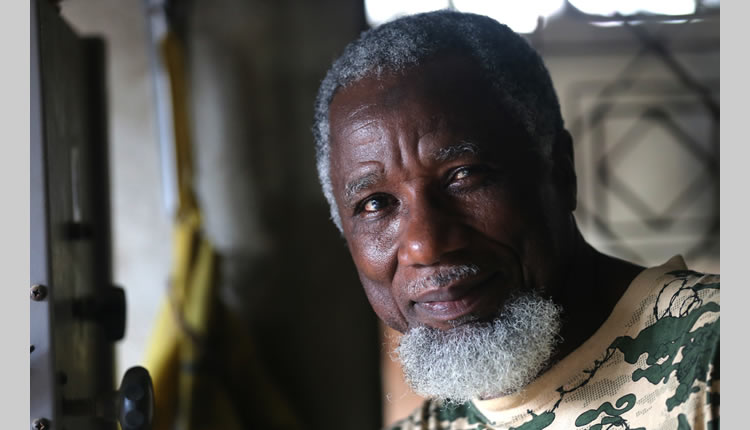

Bashorun belongs to a remarkable, but older established generation of sculptors.
FUNKE OSAE-BROWN
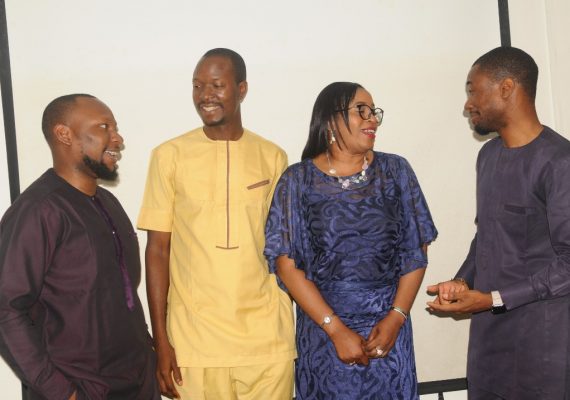
Perhaps the drops of rain falling outside The Wheatbaker, Ikoyi, Lagos, Nigeria knew something unusual was about to berth that Tuesday morning. It was the media unveiling of a joint exhibition by Raqib Bashorun and Chika Idu curated by Sandra Obiago and Oliver Enwonwu.
As I walked into the hotel lobby, thought-provoking and edgy art works stared me in the face. The pieces are uniquely rendered in different media from metal, iron to empty Coca-cola cans. One could tell that a great deal of passion must have gone into creating some of the pieces brilliantly displayed. They are the works of Bashorun.
“The statement I like to make is that I am a very passionate about the art,” says Bashorun while taking us on a tour of his works. “We can use art as a platform to jumpstart most of my works are used to depict my passion for the art. If Nigeria is going to make it, we have to look at the art. I also look very strongly at the issue of the population of Nigeria in some of the works in this exhibition.”
Bashorun belongs to a remarkable, but older established generation of sculptors who have firmly inculcated the practice of employing unconventional techniques and media including recycled and found materials in their interrogation of the larger society. As so often with his previous installations, the 14 works presented here are fashioned from his preferred media of wood and metal. However, in the last decade, Bashorun has increasingly explored new directions and possibilities with the incorporation of recycled and found material from his immediate environment, most notably metal in form of aerosol and soda cans, as well as domestic accessories like table cutlery.
One of Bashorun’s pieces titled ‘Ebb and Flow’, a 2014 work rendered in discarded soda cans which he stapled one-by-one on wood. “We need to learn to see beyond what we see before us,” Bashorun says of the work. “The ebb is there and the flow. I started using this when they just constructed a drainage in Lagos and soda cans were being dumped there. I decided to do something with it.”
Another interesting piece to see at this exhibition by Bashorun is ‘Mood 1, 2, 3’ rendered in soda can, metal and wood, which highlight different sides to life. “Life is about the good, the bad and the ugly,” explains Bashorun. “Sometimes I am inspired by the lyric of the song of Dolly Parton that I listened to. In life, you look at certain things and you feel bad. But if you have not experienced the bad, you will not know the good and vice versa. This is a work I made in 2009 when I was going through a storm.
You will also find his work, ‘Young Acrobat interesting. A 2014 piece made with stainless steel. What is instructive about Bashorun’s pieces for this exhibition is the medium and techniques through which he rendered his pieces.
“Each time I go abroad; I learn something that I have to come back to apply to my works. Most of my techniques, I also learnt from abroad. I have used different raw materials starting from the beginning to the finished products. I am not just working for the work sake; my art is not for art sake. I have also tried o introduced sound to my works. It has all the values to make it functional. I sue local materials, materials that people are familiar with.

Chika Idu on the other hand is a younger artist who has used his works to fight for social justice for women and children.
Chika Idu on the other hand is a younger artist who has used his works to fight for social justice for women and children. His strongly figurative and personal style is easily recognizable, one that traces his trajectory and stylistic development. His technique involves the exhaustive priming of his canvas. His broad oeuvre embraces themes such as traditional Nigerian ceremonies, musicians and landscapes.
Many of his paintings are imbued with narrative content. They depict children engaging in various forms of activity on the way to school, praying, reading or swimming. Idu is also an accomplished portraitist; his canvases portraying the beauty of the African woman with her pouted lips and lithe supple body, are built up thickly with palette knife and sometimes fingers.
His technique is equally unique as he created a new art form with his experimentation of the use of light against visual distortion which he discovered 16 years ago. One of his pieces to see at the exhibition is the Portrait Series where he chronicles the life to a young girl who was living with her aunt. She lost her job when she refused her boss’ sexual advances. Another piece to see is ‘Play Time’ which depicts the life children returning from school.
“I like to depict children plain in a surrealistic environment of joy away from the danger inherent in the environment. I am disturbed by the aquatic life and the activities of dredgers. I am trying to block out the sad memory with a happy one of children swimming.”
In all, the exhibition is suggestive of creative currents that continue to flow between consecutive generations of artists. This notion of interconnectedness is further accentuated by the fact that though the artists work across different media and are separated by age, Idu being considerably younger, they are brought together through several points of investigation of their intriguing art forms.
“The exhibition’s strength is hinged on the juxtaposed placement of each artist’s work; the geometric and abstract forms, as well as the rigidity and hardness of Bashorun’s sculpture against the palpable impasto, delineating the more fluid figures and forms that populate Idu’s canvases. Significantly, both artists are united by each other’s interest in the texture and materiality of his chosen media,” says Enwonwu.
Also, Obiago says it is good to show an exhibition that highlights how we present the culture vis-à-vis another creative culture. “And we decided to pair Bashorun with Idu whose works dwell on preservation of children and women rights. Bashorun’s works deal with many deep and interesting issues like politics, how do we compare with the super powers?”
The exhibition, sponsored by the Wheatbaker & Veuve Clicquot, runs from April 18 to June 16, 2016 at The Wheatbaker, Ikoyi, Lagos.
About The Author