FUNKE OSAE-BROWN
The parking lot at the National Theatre was filled on Sunday. It was a few minutes’ past 3pm. It was only a figure like Wole Soyinka that could pull that kind of crowd to the Theatre in the scorching November sun. By the time I got into the Cinema Hall 1, more than half of the seats had been occupied. The Committee for Relevant Arts (CORA) Stampede on was underway. It was an intellectual discussion of Wole Soyinka’s ‘Death and the King’s Horseman’, a play written 40 years ago. It was also the commemoration of 30 years Soyinka won the Nobel Prize for Literature.
The session was anchored by foremost art enthusiast, Ben Tomoloju who said the events written in ‘Death and the King’s Horseman’ can be related to the current political situations around the world, not just Nigeria. “We also have the Trump issue,” he observed. “We don’t know what the Trump card will be now.”
Temi Halim, one of the panellists said she encountered the play very early. According to her, although ‘Death and the King’s Horseman’ is written in English text but she interacted with it as a Yoruba text.
“Tragedy as a concept may not necessarily exist in Yoruba,” she explained, which is adapted from English. It doesn’t take anything from us if the text isn’t a tragedy. Elesin’s death is an honour not tragedy. Honour is no longer in rescue. Africa is alive and valued it works. Has African society actually moved forward after what happened in 1944? It is believed that when tragedy strikes, the society is truncated. But we have moved on.”

Elesin reassures him of who he is, and the women of the market start getting him dressed properly for the big event.
The panel also looked at the text from the perspective of death and world view on religion. Ben T said in the text, death is paradoxical as it looks at the inter-generational contestation. The generation of Iyaloja and the girl, Elesin and Olude.”
Actor Francis Onwochei and panellist took a different position on the issue of death as portrayed in the play. He argued that critics often tend to intellectualise death. “Death is death,” he said. “I find the character of Olude very intriguing. The text highlights the folly of Western civilisation.”
Segun Adefila, founder, Crown Troupe of Africa, who was also on the panel said the text is deeply rooted in the Yoruba culture as the author Soyinka communicates in Yoruba language even though the text is in English. “What you observed in the play is the cycle of life has been truncated. Olude has a father who is supposed to intervene but he never did. you see Olude in other Soyinka works like Ademoke in ‘A Dance of the Forest’ or Dawodu in a ‘The Lion and the Jewel’.
The Stampede ended at half past four as we made our way to Cinema Hall 2 to see Death and the King’s Horseman on stage by the National Troupe of Nigeria. Not a few people marvelled at the beauty of the set before them. The set design was breathtaking, a pointer to an interesting performance to be put up by the cast.
The voice of Shaibu Husseni, communication manager, national troupe jolted us back from our admiration when he announced the presence of the minister of information and culture, Lai Mohammed and other dignitaries.
The artistic director of National Troupe, Akin Adejuwon said it was the minister’s idea to have this performance. “The performance is to celebrate what has been established over 40 years ago and has also garnered what brought the Nobel Laureate to Africa 30 years ago,” he said.
Mohammed in his address said it is right to celebrate the literary gift to the world and Africa’s illustrious son. “He has continued to play vital role in the development of literary world.”
In addition, he said his ministry has signed MOUs with Tony Elumelu Foundation and British Council to further develop the creative industry. He affirmed that his ministry is working with other government agencies to nip piracy in the bud. “Piracy is as worse as robbery the user of stolen goods is as guilty as the thief. We need to get the national assembly to take a second look at bills before it especially the one on the endowment of arts.”
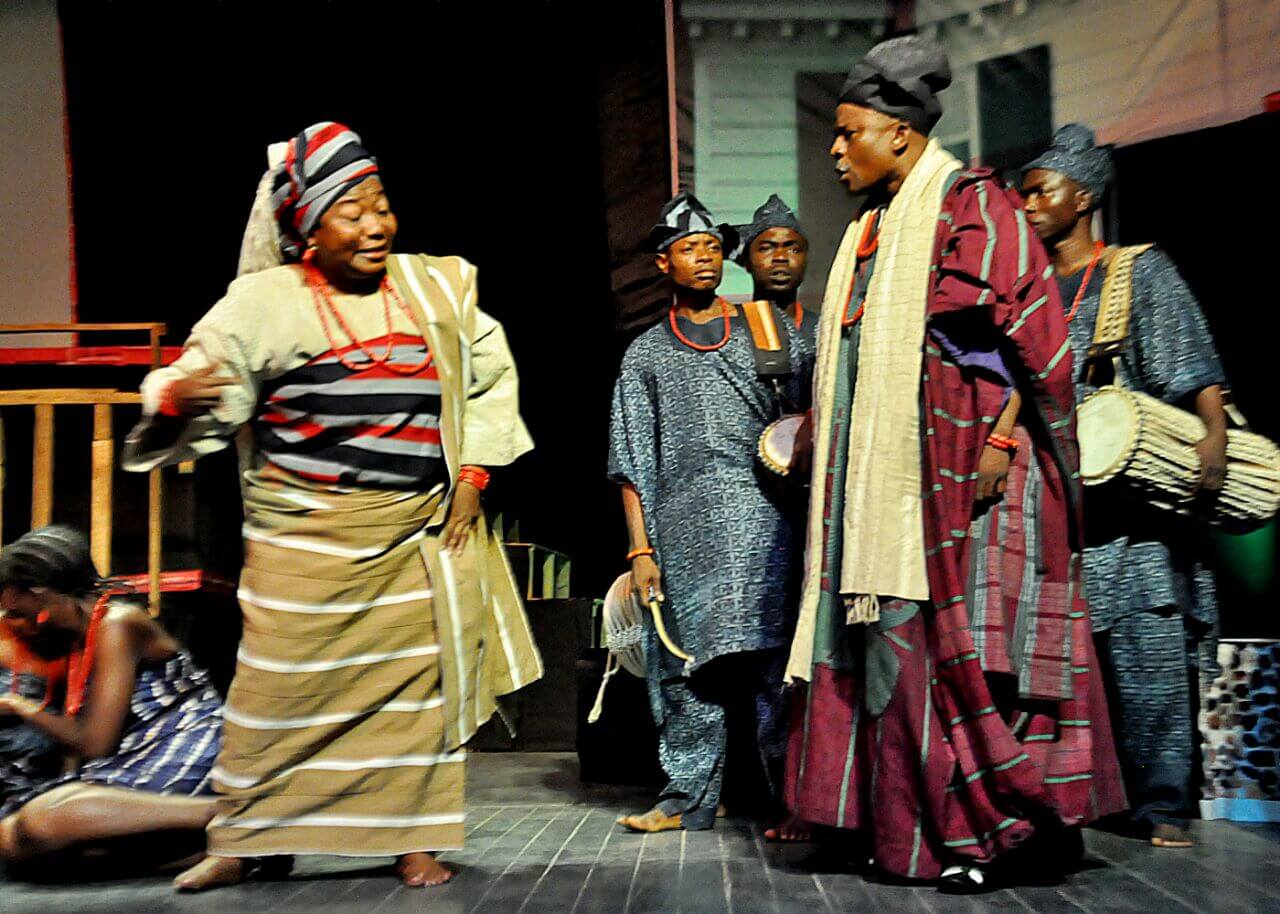
After the speeches, the performance began in earnest. The sound of drums came alive on stage so are the sonorous voices of market women and their dance steps, the famous Olohun Iyo (praise singer) and his drummers follow the main character, Elesin Oba chanting his praises. The scene was beautifully played out by the energetic characters of Elesin, Olohun Iyo, Iya Loja and her fellow market women. Their speeches were punctuated by folk songs, drums and dance.

Death and the King’s Horseman tells the story of Elesin Oba who is supposed to be the King’s forerunner.
Death and the King’s Horseman tells the story of Elesin Oba who is supposed to be the King’s forerunner. When the play opens, the king has just died, and Elesin Oba (the king’s horseman), according to tradition, must follow the king to the great beyond. This becomes necessary for the cycle of life to continue.
As Elesin gets to the market to prepare for the big transition, he is very much ready, but the Olohun Iyo who accompanies him maybe have indirectly contributed to fate that will later befall him. Elesin reassures him of who he is, and the women of the market start getting him dressed properly for the big event.
Shortly after, a pretty girl walks by who did not miss Elesin’s attention. Even though the girl is betrothed to Iyaloja’s own son, and she worries getting married will be a distraction from the task at hand, Iyaloja agrees—after all, he’s about to make a big sacrifice for their people, so how can she to turn him down? This brings a twist to the entire plot.
The National Troupe had a good outing with the performance. The costume was well thought out and designed, the cast did a good justice to the narration, songs, drumming and dance. The entire cast put up a good show.
About The Author